

Challenge
Results

Written by


Craig Crisler
The Full Story
The generative AI wave in 2022 reshaped expectations for AI almost overnight. Since then, AI has catapulted from experimental technology to a strategic business tool, particularly in CX.
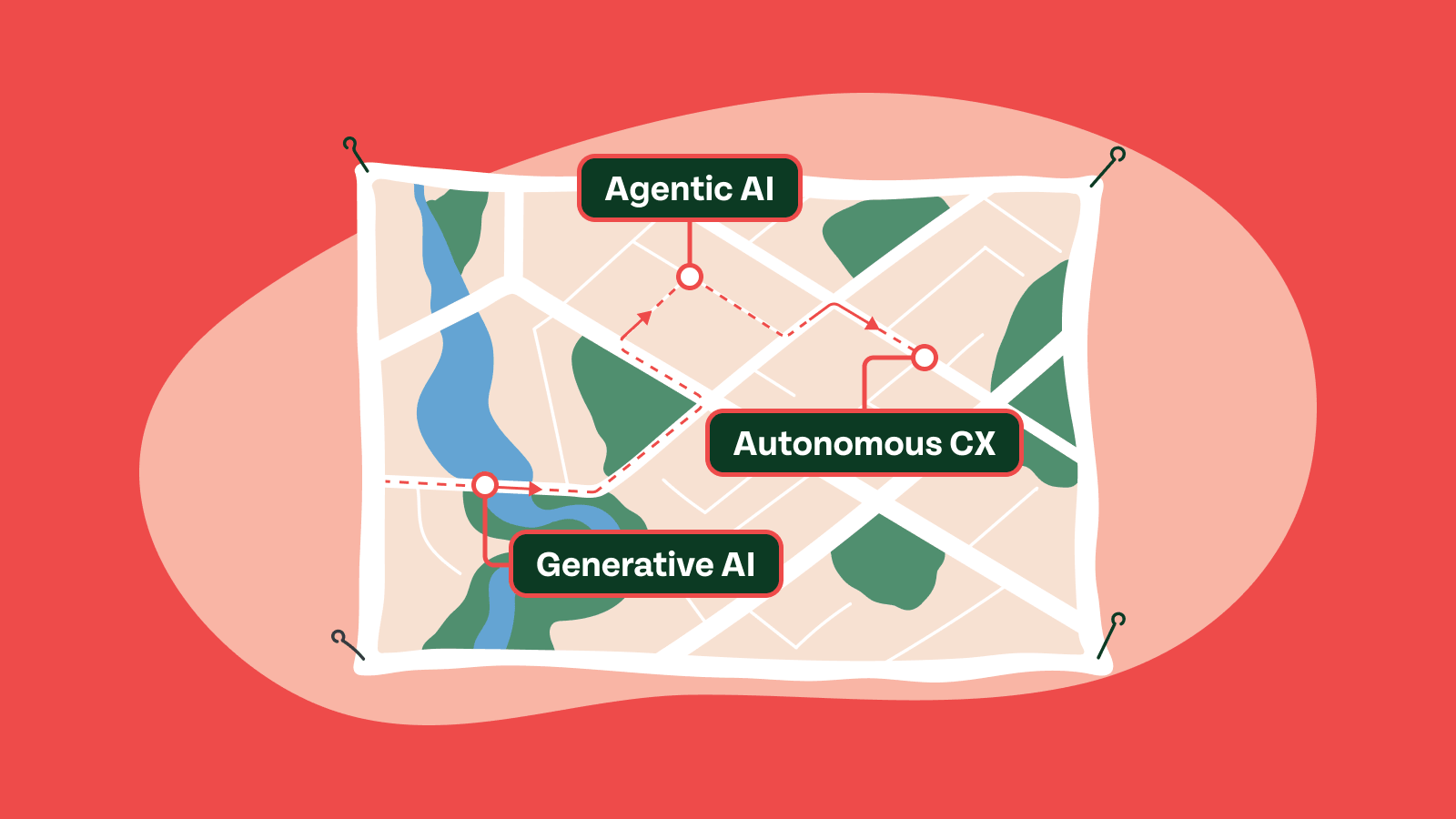
Now the conversation is shifting toward the next evolution: agentic AI.
But what defines agentic AI? Why are leaders investing in it? And how does it differ from the generative AI tools already embedded in your workflows?
Generative AI: The Tools You’re Already Using
Generative AI — the technology behind familiar tools like ChatGPT, Claude, and Gemini — creates content in response to prompts, drawing on its training data to create new outputs. It responds to requests by identifying patterns and generating text, images, or code that mimic human conversation and creativity.
Companies commonly use generative AI for:
- Content Creation — Blog articles, marketing copy, and social media content
- Sales Support — Email templates and proposal drafts
- Marketing Assets — Ad copy and campaign materials
- Product Design — Concept creation and rapid prototyping
- Customer Support — Automated responses, troubleshooting guidance, and knowledge base assistance
Agentic AI: The Next Chapter in AI Innovation
While generative AI simply generates text, images, or code based on a single request, agentic AI goes further, making decisions and executing complex tasks across multiple systems to achieve specific outcomes.
Rather than waiting for the next instruction, agentic AI plans, acts, and adapts within set parameters. It manages workflows, solves problems, and learns from results, with minimal human input required.
Agentic AI can unlock value in areas such as:
- Customer Support — Resolving complex cases without escalation
- Workflow Automation — Managing end-to-end business processes
- Financial Operations — Analyzing risk and making real-time decisions
- Robotics — Driving autonomous activity in production and logistics
Understanding AI Maturity Levels
Agentic AI is promising, but practical autonomy remains out of reach. Deploying agentic at this stage in its maturity demands careful attention to ethics, risk, and oversight.
The AI maturity spectrum includes five key stages:
- Level 0: Copilot Tools — ChatGPT, Claude, Gemini, and similar tools follow specific instructions and retrieve information
- Level 1: Recommendation Agents — Systems surface insights and suggest next steps
- Level 2: Task Automation — Systems handle routine, self-contained tasks, like scheduling meetings or sending follow-up emails
- Level 3: Workflow Orchestration — Systems manage complex, multi-step processes by planning, solving problems, optimizing workflows, and adjusting to changing goals without human intervention
- Level 4: Universal Interoperability — “Any-to-any” communication, where systems collaborate across organizations and platforms in real time (largely aspirational for now)
Currently, most organizations operate between levels 1 and 2. You’ll find some early level 3 orchestration in large enterprises.
Agentic AI’s Place in the Hype Cycle
The Gartner Hype Cycle puts agentic AI at the “peak of inflated expectations” — a stage marked by excitement and heavy investment, but with real-world success stories lagging behind.
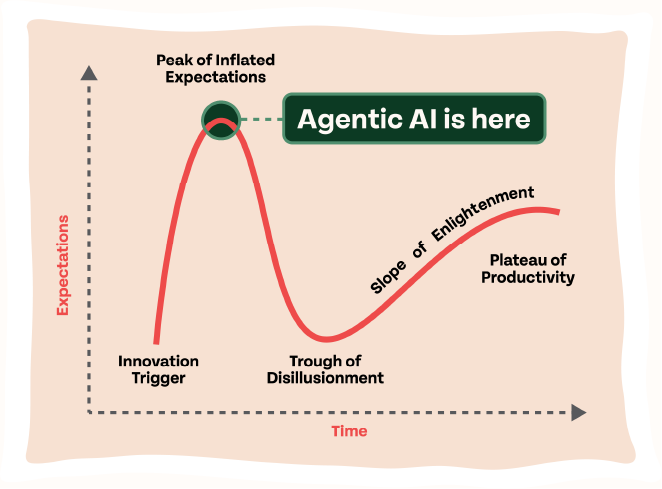
It’s easy to get caught up in the hype, but most agentic tools still require humans in the loop (HITL) to ensure accuracy, provide context, and perform quality assurance (QA). When evaluating agentic AI, focus on solutions that drive measurable results now, while building a foundation for future progress as the technology evolves.
The Future of Agentic AI in Customer Experience
While agentic AI shows promise in CX, it also has limitations that demand human guidance.
Today’s CX AI powers call routing, sentiment analysis, proactive communications, ticket deflection, and churn prediction based on rules set by your teams.
In the future, advanced agentic AI could optimize journeys on its own, learning from each interaction to improve efficiency and satisfaction without human intervention.
Emerging possibilities for CX include:
- Intelligent Routing — AI finds the best path for each inquiry
- Proactive Engagement — Systems surface customer support needs and act before issues arise
- Personalized Experiences — Systems craft dynamic, real-time content based on customer data, entirely on their own
For example, instead of just generating a response to a customer inquiry, agentic AI could anticipate follow-up needs, adjust services dynamically, generate relevant content on the fly, and even initiate proactive support.
While these advancements paint an exciting picture of the future, the path to fully autonomous CX systems will require a phased approach.
The most effective agentic AI in the near term will focus on specific, well-defined use cases, powered by structured, up-to-date data, with humans providing precise inputs and robust QA.
Strategic AI Implementation with SupportNinja
Fully autonomous agentic AI will take time. Until then, SupportNinja provides proven tech-enabled solutions backed by experienced agents and a clear path for strategic adoption as AI continues to evolve.
To drive meaningful CX transformation, we tailor our AI-driven solutions to your workflows, CX metrics, and challenges, maximizing ROI and preparing your organization for future AI capabilities.
Ready to see how AI can transform your CX strategy? Let’s talk.
Growth can be a great problem to have
As long as you have the right team.
.svg)