

Challenge
Results

Written by


Ken Braatz
The Full Story
When AI chatbot interactions go well, customers leave satisfied, interactions close without escalation, and the resulting data confirms everything worked as intended.
But that surface-level success can be misleading.
What happens when the AI is confident, the customer feels helped, and both of those signals point in the wrong direction?
If your chatbot provides outdated promotional details or incorrect store hours, the customer likely won’t find out until later, once they’ve already provided chatbot feedback. By then it’s too late, and their dissatisfaction surfaces as a chargeback, an angry support call, or churn your reporting can’t find a reason for.
So what can you do about the confident AI errors that are skewing your data and quietly damaging your CX?
Your CX KPI Dashboards Are Missing Context
When an AI chatbot gives incorrect information and the customer walks away satisfied, your dashboards can still read the interaction as a success: High CSAT shows that the customer felt their question was answered, customer effort score (CES) shows that the interaction was fast and easy, and the ticket is categorized as contained because it never required escalation.
Those signals are accurate for the KPIs they were built to measure, but they don’t show you the whole picture. You may never know your AI is actively providing incorrect information — and your dashboards have no way to look for what they weren’t designed to find.
The Limits of Chatbot Containment Rate
Containment is often used as shorthand for AI interaction quality, but what it actually measures is efficiency. Contained tickets are handled by the AI without escalation, which reduces both agent workload and cost per contact.
What containment can't show you is whether the customer received accurate information before walking away. A confidently wrong answer with no escalation still counts as a containment win, so a good chatbot containment rate can coexist with a significant accuracy problem hiding just below the surface.
One of the most common underlying causes? Garbage in, garbage out. AI amplifies the knowledge base it draws from. If your knowledge base is incomplete, out of date, or internally inconsistent, the AI will surface that bad information with the same tone and confidence as accurate information until someone catches it.
Your Chatbot’s Wrong Answers Impact Your Business and Brand Image
Customers expect your AI to give them correct information. So when the AI is convincingly wrong, customers make decisions based on bad information.
The fallout shows up in a few distinct ways:
Hidden Churn
Some customers discover the error when they try to act on what the AI told them. Maybe they arrive at a closed location or try to return an item they were told was still within the return window.
The churn in these moments often goes unexplained. The customer may never tell you what happened, so you can’t connect it to an AI accuracy issue.
Escalations and Customer Support Challenges
Customers often come back angry after receiving faulty information. Resolving the issue requires escalating past the AI to a human agent, consuming support capacity in the process. Without a defined process for resolving issues caused by AI errors, agents are left to determine the appropriate resolution on their own. Do you honor what the AI told the customer, even when it conflicts with your actual return policy? You can absorb the cost or deny the return, risking a chargeback and the customer relationship.
Loss of Trust
Faulty information can erode trust in your AI long after the original interaction.
Customers may be more likely to request a human agent during future support interactions, even for questions the AI could genuinely handle. That undermines ticket deflection strategies and creates more work for your human agents.
How Can You Reduce Confidently Wrong Chatbot Answers?
Maintaining AI accuracy requires reliable knowledge, meaningful measurement, and human oversight working together.
Update Your Knowledge Base on a Regular Cadence
Your AI can only amplify what it has access to. If your knowledge base contains conflicting, outdated, or inaccurate information, your AI can surface it with full confidence until someone stops it.
Knowledge base maintenance requires a scheduled, owned process. In practice, this may mean assigning specific sections of the knowledge base to people within the relevant functional areas, so updates don't fall through the cracks when policies change.
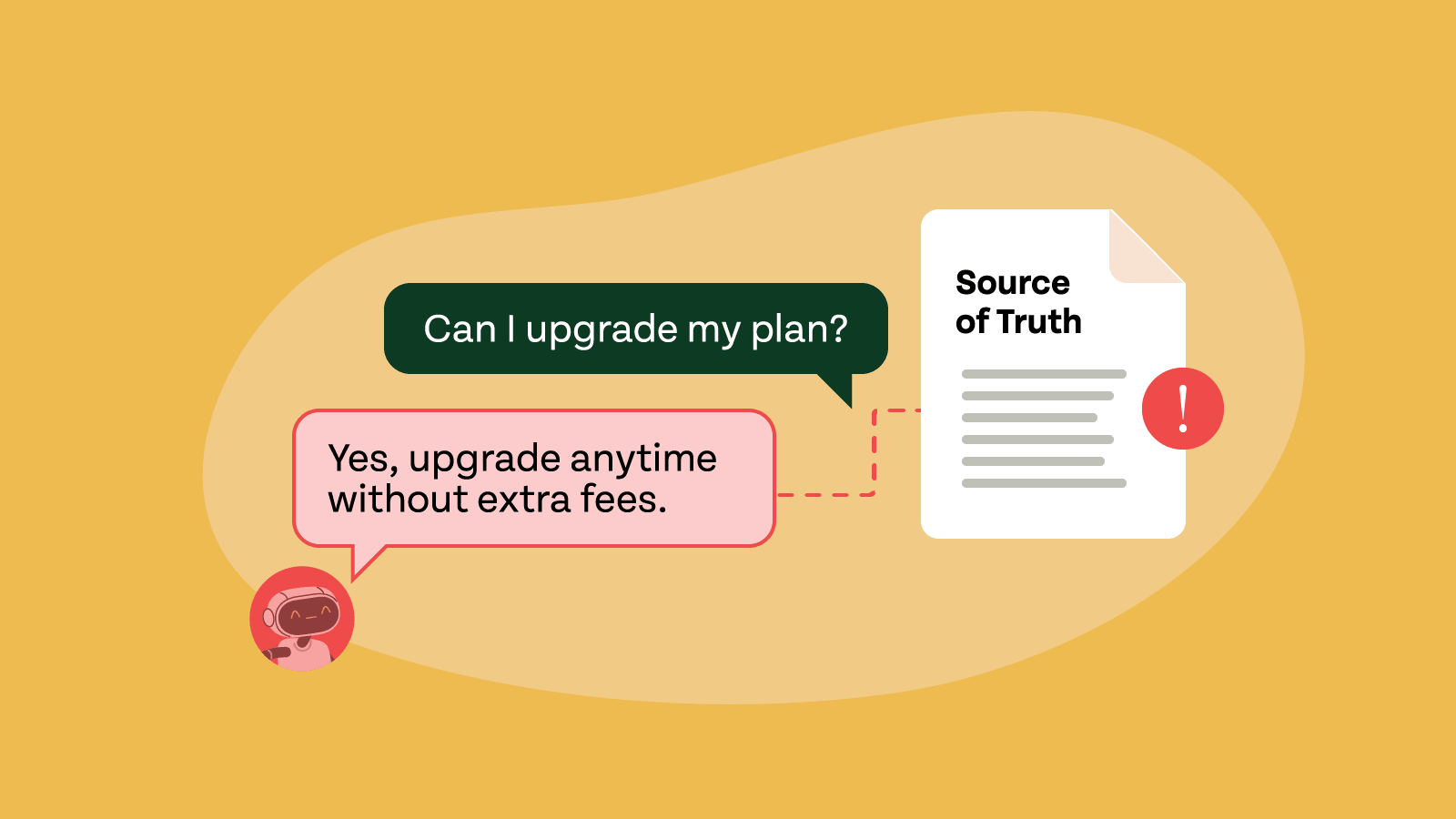
Create a Single Source of Truth
When multiple AI agents or bots pull from separate knowledge bases across different departments, customers can encounter different answers to the same question.
With all AI interactions drawing from a single source of truth, when information changes, you only have to update it in one place.
Track KPIs That Surface Hidden Problems
CSAT, customer feedback, and containment rates capture only part of what's happening in your AI interactions. A few additional metrics can help surface accuracy problems that standard dashboards miss:
- Calibration score, or expected calibration error (ECE), measures the gap between the AI's predicted confidence in an answer and its actual accuracy rate. A highly confident but frequently wrong AI is poorly calibrated
- Human-in-the-loop override rate tracks how often agents edit, reject, or ignore AI-generated outputs, which can be an early signal that something is off
- Hallucination rate measures how often the AI produces responses that diverge from the information it was given
These metrics can help surface patterns, but they still don’t replace reviewing actual AI outputs against what the correct answers should’ve been. A dashboard can tell you where to look; someone still has to verify what customers are actually being told.
Keep a Human in the Loop to QA AI Answers
As I’ve previously shared, “AI doesn't run itself, and it doesn't grade itself either.” Someone needs to own the work of reviewing AI outputs for accuracy.
Assign a Quality Analyst to review AI outputs against the source of truth and catch instances where the AI told a customer something untrue. This work needs clear ownership rather than asking someone to perform chatbot QA as a secondary responsibility.
Work with CX Experts Who Understand AI
Our CX experts understand how to build and maintain AI-enabled customer support workflows that do more than deflect tickets.
We work with you to protect against the delayed consequences — chargebacks, escalations, and eroding trust — that confident AI errors produce after the fact. With humans in the loop, AI outputs are receive human review and issues surface earlier.
Whether you're looking to fix a CX workflow that's already in place or build a new one from the ground up, MomentumLabs by SupportNinja can help you get there. Learn more about our Embedded CX Transformation solutions.
Still Have Questions?
We’re here to answer any questions you may have about improving AI accuracy and building stronger AI-enabled customer support operations. Whether you’re looking to strengthen your knowledge base, improve AI measurement, or build human oversight into your workflows, SupportNinja helps companies create AI-enabled CX that works better for customers and the business.
Our chatbot metrics look good. Could there still be an accuracy problem?
Yes. Your metrics can show a successful interaction without telling you whether the AI gave the customer accurate information. A confidently wrong response can produce high CSAT, a low effort score, and a contained ticket, all while quietly setting up a chargeback, an angry call, or churn later. The interaction reads as a win even though the customer walked away with bad information.
What is the impact of incorrect chatbot answers?
Wrong answers create hidden churn, costly escalations, and eroded trust.Customers may act on bad information and churn without explaining why. Those who come back may be less willing to engage with AI in the future, creating more work for your human agents.
Can SupportNinja help if our AI workflow is already live?
Yes. Whether you're optimizing a workflow that's already running or building one from scratch, SupportNinja can help. We take a tech-agnostic approach, working with your existing tools when they serve you well and recommending better-fit solutions when they don't. We can also help you tighten knowledge base ownership, set the right accuracy metrics, and design escalation and QA processes that help maintain AI accuracy and brand consistency as you scale.
Growth can be a great problem to have
As long as you have the right team.
.svg)