

Challenge
Results

Written by


Omeed Jafari
The Full Story
In CX, balancing AI and human support often comes down to knowing when to use each.
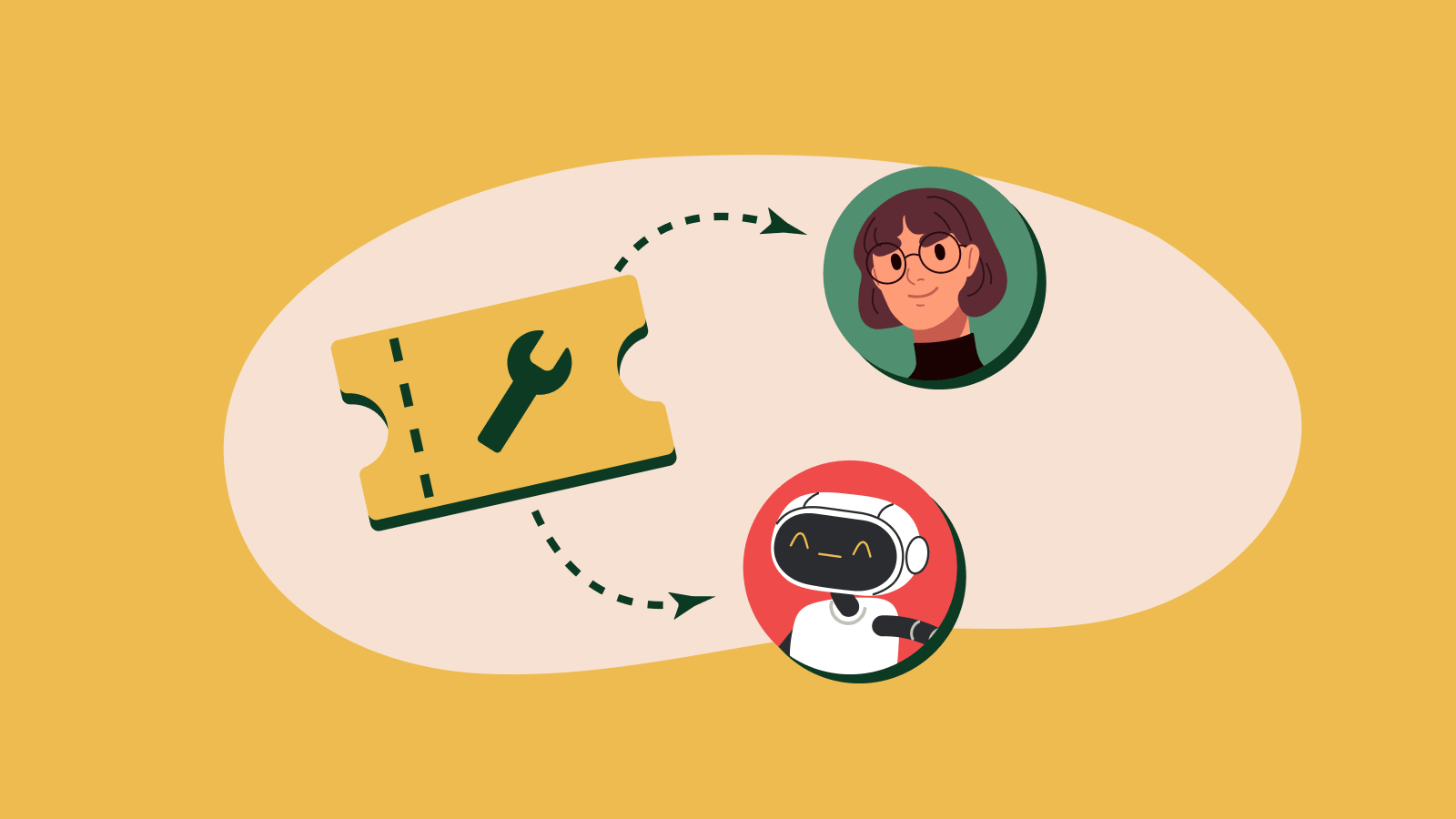
Routing the wrong interaction to the wrong resource wastes time, builds frustration, and erodes customer trust. But with the right framework, intelligent ticket routing can help you resolve issues faster, use human judgment where it counts, and deliver better customer experiences.
Let's explore the key factors that should drive your customer support routing decisions, along with three common routing pathways to help you put those factors into action.
Considerations for Ticket Routing to AI or Humans
The most successful ticket routing relies on evaluating several key factors:
Complexity
Consider the steps required to solve the problem. If a scenario requires a single step, produces a predictable outcome, and remains consistent regardless of the user, automation can easily handle it.
Even some multi-step support items still follow a defined, structured pattern for resolution, making them perfect for automation. As long as the system is simply executing a clear sequence of steps, automation can work well.
However, if a ticket is ambiguous, involves competing signals, or requires synthesizing incomplete information, a human agent should step in to read between the lines and gather the missing context.
Similarly, multifaceted requests that bundle several loosely related issues together can confuse AI systems, so human agents are often the better choice to untangle the complexities and address each component effectively.
Emotional Stakes
Automation works best when the interaction is straightforward and transactional, and the customer feels relatively neutral about the outcome. In these cases, the exchange is mostly about getting basic information or accomplishing a simple task.
If a customer is mildly frustrated but not in active distress, either a bot or a human can handle the issue, depending on the stakes. But when a customer is clearly upset, anxious, grieving, or facing a significant personal impact, empathy is non‑negotiable and their request should be handled by a human agent.
Data Availability
If your AI system has access to the necessary data, a current and governed source of truth, and the platform integrations required to take action, automation may be able to resolve the issue.
When gaps exist, information is outdated or unreliable, or the resolution requires access to platforms your automation can’t reach, a human should take over. Improving integrations and keeping the knowledge AI relies on current can expand the situations automation can handle effectively.
Compliance and Risk
When an inquiry aligns perfectly with standard policy and carries no regulatory, legal, or financial risk, automation can safely process the request.
Requests involving regulated data, legal implications, financial exemptions, or case-by-case policy decisions carry significant risk. We recommend routing these high-stakes interactions directly to a human from the start.
Resolution Authority
Evaluate how much judgment the situation demands. A clear, black-and-white answer that doesn't require additional approval fits perfectly into an automated workflow.
Some edge cases may require human authorization or specific system access. Anything requiring judgment, escalation, or a decision outside of standard policy needs a person involved. Leaving nuanced resolutions entirely to automation frustrates customers and damages their trust in your brand.
Relationship Context
If a customer’s history has no impact on what you do next, an automated agent can usually resolve the request. When a customer requests tracking information for the first time, their overall profile isn’t relevant and doesn’t impact the way the request is handled.
When past interactions, loyalty tiers, or shopping behaviors start to matter, personalization becomes more nuanced. AI can leverage data points like segments or recent activity to personalize responses, but it struggles when expectations are unclear or stakes are high. In these moments, human agents are the better choice — they’re better able to interpret gray areas and apply judgment based on the customer’s full story.
For example, repeat contact within a defined window may trigger a handoff to a human agent who can make exceptions or prioritize the issue based on context.
Reversibility
Consider what happens if the AI gets it wrong. Some mistakes are relatively easy to recover from. An incorrect order status may lead to another customer contact, while an incorrect warranty denial could lead to a dispute, chargeback, or regulatory issue.
The harder a decision is to reverse, and the greater the consequences of getting it wrong, the stronger the case for human involvement.
Support Ticket Routing Pathways
After taking these dimensions into consideration, you have a few options. Consider these three main pathways:
Route to AI
These situations feature low stakes, require black-and-white answers, and trigger predefined actions without any need for human judgment. Examples include:
- Password reset requests
- Order status or tracking lookups
- Frequently asked questions (i.e., return policies, shipping rates, business hours)
- Subscription plan details
- Store locator inquiries
Send these inquiries to automation first, with clear rules for when to escalate. Define exactly what a seamless handoff looks like so customers never feel like they’re starting over.
AI Intake and Human Resolution
These scenarios often start with an automated workflow, but as more context emerges, the conversation transitions to a live agent for decisions and final resolution. Examples include:
- Billing disputes
- Damaged item claims
- Troubleshooting (i.e., automation runs through predetermined steps and escalates to a human if they fail)
- Service quality complaints
- Warranty claims
Here, automation does work up front — like collecting details, running through standard steps, and reducing handle time — before handing the interaction off to a human agent. This keeps agents focused on judgment calls and loyalty‑building moments instead of repetitive data collection.
Route to a Human
Some interactions should go to a human agent as quickly as possible, even if AI handles the initial routing.
Use this pathway when the stakes are high, the situation is complex, or compliance and reputation are on the line. Examples include:
- Legal and regulatory complaints
- Formal escalations
- High-value or VIP account communications
- Public relations inquiries
- Bereavement or deceased account handling
- Customers asking for escalation or explicitly stating, “Let me talk to a person”
Unlike the “AI Intake and Human Resolution” pathway, where automation does meaningful work up front before handing off, these are situations that should be owned by a human from the very beginning. Automation can still play a light intake role — capturing basic details and routing — but it should not attempt to troubleshoot, negotiate, or resolve the issue.
Optimize Your CX with a Balanced Ticket Routing Strategy
Sorting your tickets into pathways is the first step, not the finished product. Every routing decision you make today is correct for the conditions you made it under. Products change, policies get updated, and AI capability moves. The rules stay where you left them.
That’s the part most teams underestimate. Building the routing logic is a project with an end date. Keeping it correct is an ongoing job.
At SupportNinja, we do that work inside whatever platform you already run. We’re not selling you a routing engine. We review whether your routing is still making the right calls, identify where it needs to change, and bring you recommendations to approve. Learn more.
Still Have Questions?
We’re here to answer any questions you may have about customer support ticket routing and determining where AI and human agents add the most value. Whether you’re looking to improve routing decisions, balance automation with human judgment, or increase efficiency without sacrificing customer experience, SupportNinja helps companies transform CX into a strategic advantage.
How can we determine if our routing strategy is working effectively?
Track key CX metrics for each pathway, along with how often AI flows escalate to humans. Layer that data with agent and customer feedback, then refine your routing rules over time. SupportNinja can turn those insights into concrete routing changes.
What factors matter most when deciding to route a ticket to AI or a human?
Focus on factors like complexity, emotional stakes, data availability, compliance risk, resolution authority, and relationship context. Simple, low-risk, and repeatable requests are strong candidates for automation, while ambiguous, high-stakes, or emotionally charged issues are better routed to human agents.
We know our routing strategy needs work. How can SupportNinja help?
SupportNinja can audit your current customer support flows, identify where automation and human agents are most effective, and translate those insights into clear routing rules. Taking a tech-agnostic approach, our specialists optimize your tech stack and design escalation paths to route tickets consistently to the right resource, driving improvements in resolution time and CSAT.
What kind of intelligent routing solutions can SupportNinja provide, and how do they work?
We start with the systems you already have. Many helpdesk, CRM, and AI platforms have routing capabilities that go unused, making configuration an important place to look before adding new technology. Our specialists work inside your existing stack to define the routing rules, build the escalation triggers, and set up the handoff logic your pathways require.
Where a genuine gap exists, we build the connective automation to close it. That might mean passing context between two systems that don’t talk to each other or triggering an action your platform can’t execute on its own. We build it in your environment, we document it, and you own it.
The ongoing part matters more than the build. Routing rules decay as products change, policies get updated, and AI capability shifts, and that decay is quiet until it surfaces in CSAT or churn. We review routing performance on a defined cadence, log every escalation and what triggered it, sample the interactions your AI resolved without escalating, and bring changes back to your team as recommendations you approve.
Growth can be a great problem to have
As long as you have the right team.
.svg)