


Challenge
Results

Written by


Craig Crisler
The Full Story
Outsourcing trends point to a clear shift. Organizations now expect more than additional capacity from their outsourcing partners.
Instead of duplicating internal workflows at a lower cost, organizations want strategic partners who offer unique strengths — specialized expertise, advanced tools, and a focus on innovation, flexibility, and scalability.
This demand for more strategic value is reshaping the landscape. Companies are moving away from the legacy model of simple cost savings in favor of partners who help them prepare for tomorrow, not just save money today.
Capacity vs. Capability: What’s the Difference?
To understand this shift, it helps to compare the old model for outsourcing strategy with the new one.
Traditional, Capacity-Focused Outsourcing
This is the legacy model that views outsourcing strictly as a lever for labor arbitrage. The primary goal is to reduce operational costs by delegating specific, repetitive tasks to a lower-cost workforce. In most cases, the outsourcing provider simply replicates existing workflows without improving them.
Capability-Focused Outsourcing
In this model, the outsourcing provider is a strategic partner, leveraging their expertise to drive transformation and deliver long-term value. The partner brings specialized knowledge to optimize processes, implement new technologies, and guide the organization through meaningful improvements.
In our 2026 CX Outsourcing Report, 65% of CX leaders say cost savings are important, but only 22% say it’s the primary driver of their approach. This shows that reduction still matters, but it no longer defines outsourcing strategies.
Why Strategic Outsourcing is Gaining Ground
Outsourcing demands are changing because CX leaders now face priorities beyond traditional customer support management.
In addition to meeting customer expectations, they must drive innovation, advance AI initiatives, and refine operating models to achieve meaningful transformation.
Recognizing these expanded responsibilities, the majority of CX leaders see outsourcing partnerships as a valuable opportunity to gain strategic support — 54% say vendors should act as strategic partners.
The problem is that legacy outsourcing vendors haven't changed their models to match those expectations. Their engagements are still measured primarily by service level agreement (SLA) delivery, without considering the broader strategic KPIs that impact long-term business growth.
This disconnect creates frustration. The vendor may deliver on SLAs, yet the partnership struggles to evolve to support future needs.
SLAs remain important for ensuring baseline performance. But relying on them exclusively creates a narrow, transactional approach that fails to address evolving customer needs, foster innovation, or align with the organization's larger strategic goals.
How to Find a Strategic Outsourcing Partner
If you want capability instead of simple capacity, you need to vet partners differently. But how can you identify a vendor who can actually drive strategy?
Define "Strategic Partner" for Your Organization
Without a clear definition of strategic partnership, you risk misaligned expectations and missed opportunities for optimization.
Be specific about what a strategic, capability-focused outsourcing engagement should look like, whether it’s aligning on CX priorities, co-owning workflows, or tapping into your partner’s expertise for benchmarking and insights. This clarity ensures both parties are aligned on shared goals.
Emphasize Transformation Metrics
Look for a partner that measures success with transformation metrics that reflect your broader goals, such as first contact resolution (FRC), AI effectiveness, or customer sentiment analysis. If a vendor can’t track these metrics, they will struggle to improve them.
A true strategic partner will go beyond surface-level performance, offering transparent, data-driven insights that demonstrate how their support enhances CX and operational efficiency. They’ll proactively monitor, evaluate, and refine their approach to ensure it evolves alongside your needs.
Reel in Vendor Sprawl
If you have five different vendors doing five different siloed tasks, you lose the ability to drive a cohesive strategy. Vendor sprawl often leads to siloed metrics, where each provider focuses on isolated KPIs without considering the bigger picture.
Look for a partner who can consolidate and streamline your efforts. When evaluating providers, ask how they approach unifying workflows and metrics to create a strategy that’s cohesive across the full CX lifecycle.
Outsource with Strategy in Mind
As companies face increasing pressure to innovate, scale, and deliver exceptional CX, expanding capacity through labor arbitrage is not enough. Strategic, capability-focused partnerships are the future of outsourcing.
At SupportNinja, we look beyond the SLA to find areas for optimization. Whether we’re identifying friction in the customer journey, integrating AI into your workflows, or implementing changes based on actionable insights, our goal is to help you achieve company-wide objectives, both today and in the long term.
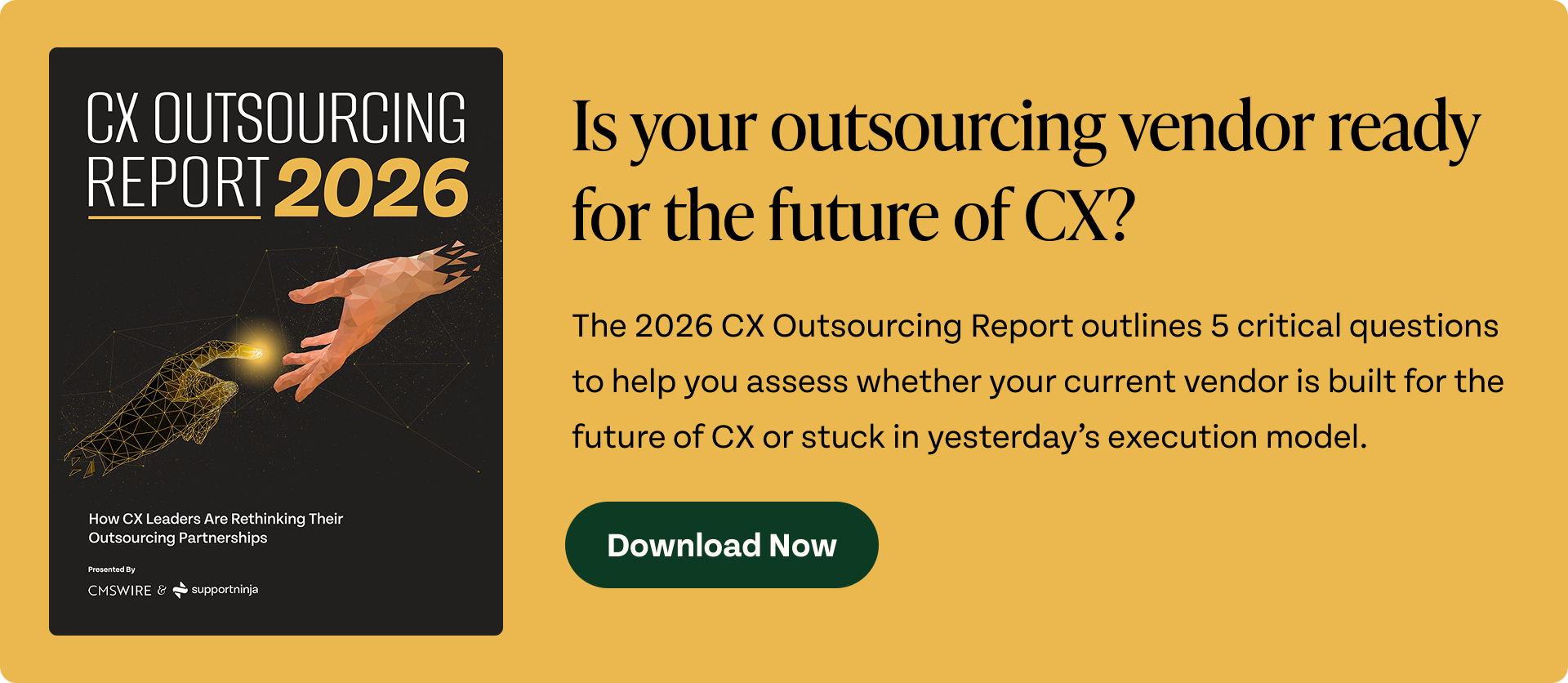
Want to explore more trends shaping outsourced CX in 2026? Download the full report.
Growth can be a great problem to have
As long as you have the right team.
.svg)