

Challenge
Results

Written by
.png)

SupportNinja
The Full Story
Insights From the CMSWire x SupportNinja Webinar
Customer expectations continue to rise. AI is reshaping how work gets done. And the pressure to improve efficiency while delivering better outcomes has never been higher.
At the same time, many companies are asking a fundamental question: How do we know where our CX operation actually stands?
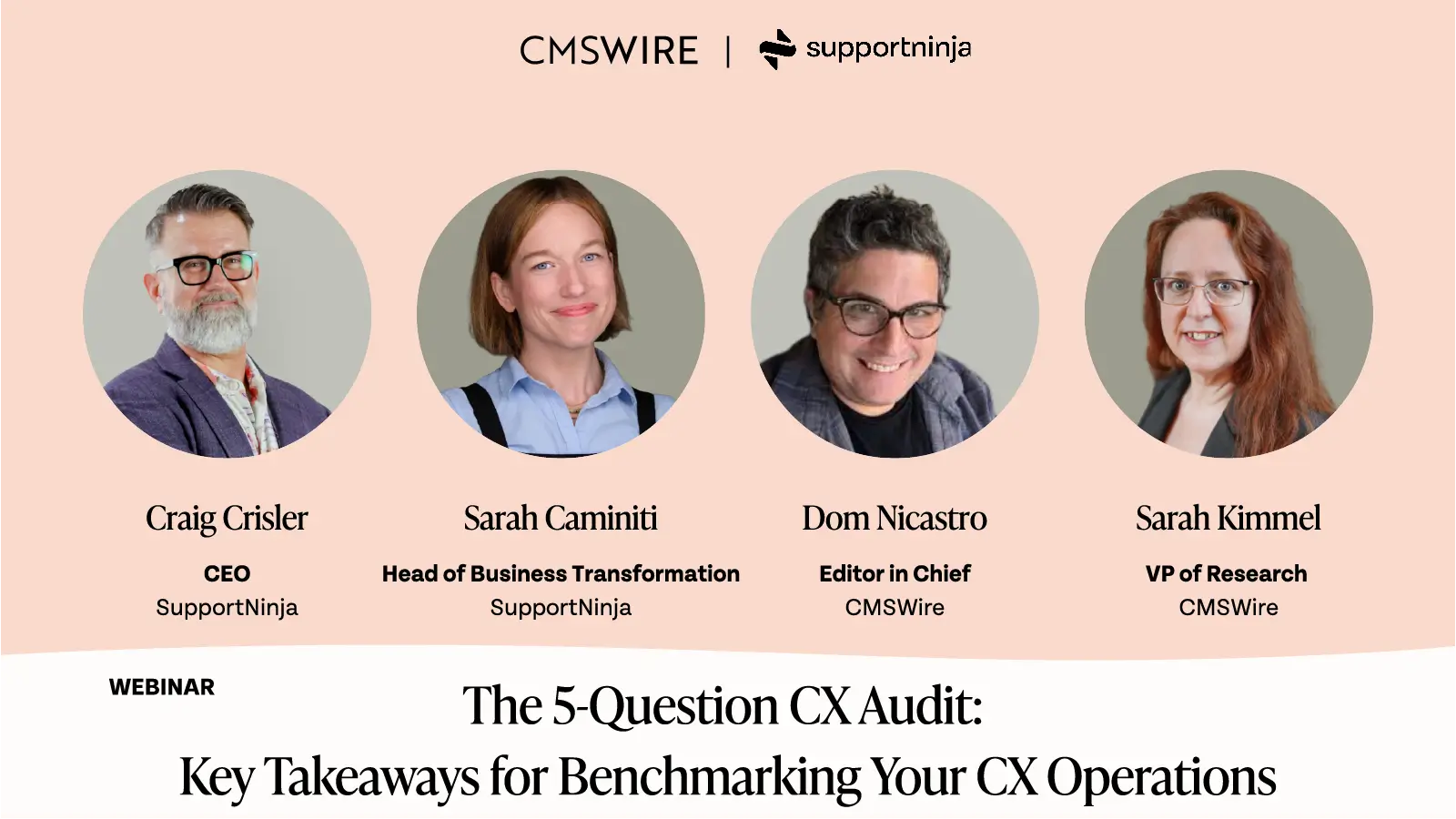
This was the focus of a recent CMSWire webinar featuring Editor-in-Chief Dom Nicastro and VP of Research Sarah Kimmel from CMSWire, along with CEO Craig Crisler and Head of Business Transformation Sarah Caminiti from SupportNinja.
Drawing on findings from the 2026 CX Outsourcing Report, the panel explored what separates companies that are making meaningful progress with AI, outsourcing, and CX transformation from those struggling to move beyond experimentation.
Why Satisfied Customers Are Still Reevaluating Vendors
One of the most important findings from this year’s research is that satisfaction and loyalty are no longer moving in lockstep.
While 84% of CX leaders reported being more satisfied with their outsourcing partners than they were a year ago, 79% said they’re actively evaluating alternatives.
At first glance, those findings seem contradictory. In reality, they reveal how rapidly customer experience is evolving.
Companies aren’t necessarily dissatisfied with their current providers. Many are simply facing new challenges that their existing partnerships weren’t designed to solve. AI adoption, operational complexity, changing customer expectations, and pressure to improve business outcomes have created a demand for new types of expertise.
Leaders increasingly want partners who can help them navigate change, identify opportunities, and contribute to strategic conversations. They’re looking beyond service delivery and asking a different question:
Can this partner help us build the future of our customer experience?
Transformation Is Bigger Than Technology
Another key theme from the discussion was the growing confusion around the word transformation.
Many companies equate transformation with implementing new technology. But deploying a new tool is only one small piece of the equation.
True transformation changes how work happens.
Transformation is often less about becoming something entirely new and more about rearranging the capabilities you already have. Like a Transformer, effective transformation comes from using existing capabilities differently, connecting processes more effectively, and creating better outcomes through smarter operations.
That starts with defining what success actually looks like.
Before introducing new technology, leaders need clarity around the business outcome they’re trying to create. Without that clarity, it’s easy to mistake activity for progress and implementation for transformation.
Technology can accelerate change, but it can’t create transformation on its own.
Why Most AI Challenges Aren’t Technology Problems
The discussion also highlighted an important distinction between AI adoption and AI operationalization.
According to the research, 84% of organizations say their AI initiatives are meeting or exceeding expectations. Yet only 23% have fully operationalized AI across their core CX workflows.
The challenge isn’t getting AI to work.
The challenge is integrating AI into day-to-day operations in a sustainable way.
Companies often focus on selecting the right tool while overlooking the operational infrastructure required to support it. Governance, knowledge management, quality assurance, ownership, training, and human oversight all become increasingly important as AI deployments scale.
Successful leaders recognize that AI is not a set-it-and-forget-it solution.
Knowledge bases must remain current. Processes must evolve alongside changing customer needs. Human oversight must ensure that AI outputs remain accurate, aligned, and useful.
The strongest AI results come from treating AI as part of an operating model rather than as a standalone technology initiative.
CX Teams Are Becoming Strategic Intelligence Centers
Historically, CX teams have often been viewed as service functions.
That perception is changing.
CX sits closest to customer problems, customer feedback, and customer friction. As a result, they often have access to operational intelligence that other parts of the business may not see.
Frontline professionals often identify product and engineering issues first because they hear directly from customers every day.
AI is accelerating this shift by helping companies analyze customer feedback, identify patterns, and surface trends faster than ever before.
As customer insights become more accessible, CX leaders are gaining greater influence over technology decisions, operational improvements, and business strategy.
CX creates the most value when it’s treated as a source of operational intelligence rather than simply a support function.
The Four Stages of CX Maturity
To help companies benchmark their progress, SupportNinja introduced a CX maturity framework that identifies four stages of operational development.
Emerging
Companies at this stage are often highly reactive. Knowledge management is inconsistent, manual work dominates daily operations, and teams spend most of their time responding to customer issues rather than identifying root causes.
Structured
Processes become more standardized, documentation improves, and teams begin creating repeatable systems. However, insights often remain isolated within individual departments.
Advanced
Companies start connecting customer insights across functions. Data becomes more actionable, and CX teams play a larger role in identifying opportunities for operational improvement.
Predictive
At the highest level of CX maturity, CX influences decisions across the business. Teams proactively identify trends, anticipate customer needs, and use customer insights to guide product, operational, and strategic decisions.
Moving higher on the maturity ladder creates an environment where customer feedback consistently drives better business decisions.
Build Momentum Before You Build Transformation
For leaders feeling overwhelmed by the pace of change, here’s a practical reminder:
You don’t need to transform everything at once.
Many companies assume progress requires a massive technology investment, a complete process redesign, or a large-scale organizational initiative.
In reality, transformation often begins with smaller actions that create momentum.
Improving a knowledge base. Documenting a workflow. Reviewing customer feedback trends. Creating time for strategic analysis. Establishing a maintenance process.
These actions may seem incremental, but they create the foundation for larger improvements over time.
Meaningful progress comes from consistently building toward a clearer vision of what good looks like.
From Insight to Action
The CX landscape is changing quickly, but the fundamentals remain the same.
Companies still need clear strategy. They still need strong operational foundations. They still need customer insights that drive meaningful action.
The difference is that AI, automation, and evolving customer expectations are accelerating the pace of change.
Leaders who focus on operational readiness, strategic partnership, and continuous improvement will be best positioned to adapt.
Transformation doesn’t begin with a tool.
It begins with understanding where you are today and building momentum toward where you want to go next.
Ready to benchmark your CX operations? Explore the findings from the 2026 CX Outsourcing Report and see how your company compares.
Growth can be a great problem to have
As long as you have the right team.
.svg)